BC Place – Session 5, Wednesday, May 31, 2006 from 08:30 – 10:00
Abstract Title: Building Capacity for Public Health in BC – Mapping Public Health
Presenting Author:
James Leslie and Nora Whyte
Independent Health Services Planning Consultants
1831 Trafalgar Street
Vancouver, BC V6K 3S1
Shannon Turner, President
Public Health Association of BC
#219 – 2187 Oak Bay Avenue
Victoria BC V8R 1G1
Background:
This panel presentation will be a report on work that is currently underway. We will review our progress to this point, talk about what we have learned, and describe our next steps. We will then open the floor to discussion and seek observations and suggestions that may help us in continuing our work.
Project Goals:
This project will help to “map out” the basic infrastructure of public health services. It will focus on both mandated, legislated public health functions and the broader field of activities covered in health promotion and population health activities. It will serve as the first phase of a more comprehensive initiative to understand and better define the resources applied, how they are organized, how services are made accessible, the differing roles of the many organizations and agencies in the field and the capacity building functions of the academic sector. The completion of this project will enhance our ability to advocate for public health with policy makers and with our broader constituencies in community based organizations. The map will also be a tool in our efforts to organize a coalition that will give a unified voice to public health in BC.
Methods and Objectives:
• Define the scope of the map and determine what data and information would be available to us.
• Develop survey process to seek out the views of public health practitioners in the field with a focus on workplace and community issues-working life at ‘the coal face.
• Determine who our audiences would be.
• Coordinate the mapping piece with elements of a broader project to ‘Build Capacity for Public Health in BC.
• Initiate consideration of the design of the web site which is to be the vehicle for dissemination of the map.
Challenges and Results:
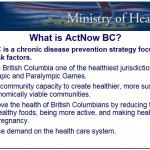
The project could be successful only if it were complementary or at least in sync with the numerous large-scale transformative changes underway in all areas of the health sector in BC. Examples of processes that needed to be considered were implementation of the Core Functions Framework, structural changes within each of the province’s Health Authorities, health promotion initiatives with municipalities, Act Now and the Healthy Living Alliance initiatives and a new interest in public health among First Nations and Aboriginal organizations as a result of the Kelowna Accord.
The atmosphere was one of furious activity, many of those we wanted to contact were not easily contacted and were leery of our imposing new demands on their already overburdened schedules. Our workplan was driven by project timelines that were widely divergent from our needed respondents.
Given the breadth of the field of public health and the diversity of interest and approaches within that field we found our resources stretched as we experienced the dread of ‘scope creep’.
We have had to persistently remind ourselves that we are not producing a finished product, a Report that will signal an end to our toils; we are producing a first layer of a resource that will be broadened, deepened and refined over time as it becomes useful to those working in the field as practitioners, policy makers, citizens, politicians and partners. We are also creating an information clearing house that will require ongoing maintenance if the information is to be current and relevant.
Conclusions:
This project has been an enormous challenge across many dimensions. Much has been learned, much remains to be done.
BC Place – Session 5, Wednesday, May 31, 2006 from 08:30 – 10:00
Abstract Title:
Healthy Aging Through Healthy Living
Presenting Author: Tessa Graham, MA, BA
Executive Director
Healthy Children, Women and Seniors Branch
BC Ministry of Health
4th Floor, 1515 Blanshard Street
Victoria BC V8W 3C8Matt Herman, MSc, BSc(Hons)
Injury Prevention Manager
Healthy Children, Women and Seniors Branch
Donelda Eve, BJ
Manager, Healthy Again
Healthy Children, Women and Seniors Branch
Additional Authors:
Andrew Hazlewood
Assistant Deputy Minister
Population Health and Wellness
BC Ministry of Health
4th Floor, 1515 Blanshard Street
Victoria, BC V8W 3C8
Background:
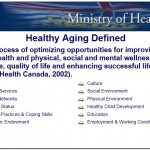
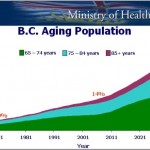
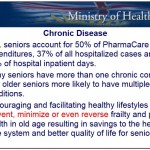
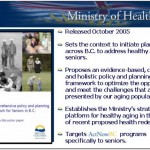
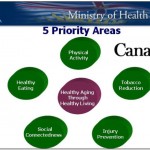
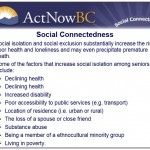
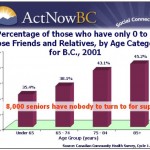
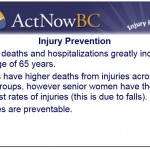
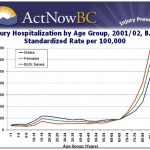
British Columbia has one of the most rapidly aging populations in Canada. By 2031, 24 percent of British Columbia’s population will be over the age of 65. A discussion paper Healthy Aging Through Healthy Living: Towards a comprehensive policy and planning framework for Seniors in BC was released in October 2005 and provided the evidence base to initiate the development of a healthy aging framework. The paper details five key priority issues that researchers have identified as crucial to healthy aging, namely: healthy eating, physical activity, tobacco reduction, injury prevention and social connectedness.
Objectives:
To present the evidence on seniors’ healthy living and report on the outcomes of the healthy aging expert panel meeting held in March 2006.
Methods:
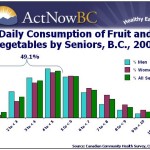
Experts on healthy aging were brought together in March 2006 to come to a consensus on the priority issues for health aging of BC seniors. The most current data from Statistics Canada’s Canadian Community Health Survey (Cycle 2.1, 2003; Cycle 2.2, 2004) was used to provide an insight into the personal health practices on BC seniors. The panel set the agenda for regional consultations on the development of a provincial healthy aging framework.
Results:
Significant healthy lifestyle priorities were identified for BC seniors to enable the achievement of healthy aging.
Conclusions:
Encouraging seniors to lead healthy lifestyles can prevent, minimize or even reverse frailty and poor health, resulting in a better quality of life for BC seniors and savings to the health care system.
BC Place – Session 3, Tuesday, May 30, 2006 from 10:30 – 12:00
Abstract Title: Healthy Opportunities for Preschoolers (HOP): Enabling family childcare providers to build foundations for healthy lifestyles
Presenting Author:
Dr. Patti-Jean Naylor
Assistant Professor, School of Physical Education
University of Victoria
PO Box 3015, STN CSC
Victoria, BC V8W 3P1
Additional Authors:
Dr. Viviene Temple
Associate Professor, School of Physical Education
University of Victoria
PO Box 3015, STN CSC
Victoria, BC V8W 3P1
Objective:
To determine the impact of a train-the-trainer model for disseminating a movement skills program for family childcare providers in BC.
Methods:
Family childcare is an influential setting for the development of health promoting behaviours. About half of children in non-family care are in family childcare.
A physical activity and motor skill development resource and training workshop for family childcare was developed in collaboration with the Vancouver Island Health Authority. BC Ministry of Children and Families Development funding supported a provincial train-the-trainer. Childcare resource and referral agencies and public health nurses were recruited (n=40). Training was 16 hours and trainers received manuals, small workshop support grants and committed to deliver workshops in their regions. Trainers and subsequent workshop participants completed pre-post workshop evaluations measuring knowledge, confidence and intention to use what they learned.
Results:
Trainers (n=39) significantly increased their knowledge (p<.0001) and confidence (p<.001) related to providing movement workshops for care providers. Childcare providers trained by the trainers (n =231) increased their knowledge (p<.0001) and confidence in their ability to provide appropriate movement experiences for preschoolers (p<.0001). Participants at both workshop levels were highly satisfied with the training and 86% of care providers intended to use what they learned in their childcare.
Conclusions:
The HOP train the trainer increased confidence of trainers and in turn more than 200 family childcare providers increased their knowledge and confidence in their ability to promote physical activity through appropriate movement experiences. Further evaluation should examine the impact of the training on physical activity levels and motor skill acquisition of children.
BC Place – Session 4, Tuesday, May 30, 2006 from 15:00 – 16:30
Abstract Title: Assessing the effectiveness of informative video clips on Farsi-speaking immigrants’ perception toward and intention to use BC HealthGuide Services in GVA
Presenting Author:
Iraj Poureslami
Adjunct Professor IHPR and UBC
Additional Authors:
Dr. Irving Rootman, Professor
Centre for Community Health Promotion Research, UVIC
Ellen Balka, Professor
School of Communication, SFU
Objective:
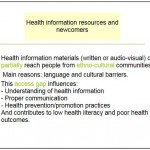
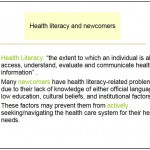
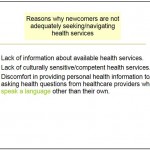
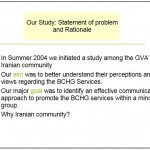
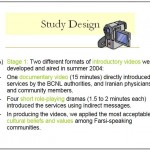
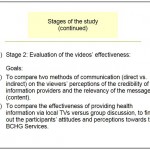
This study aims to assess the effects of broadcasting a series of videos, intended to provide information about the BC HealthGuide program in Farsi, on the awareness about and the patterns of the service usage among Farsi-speaking communities in the Greater Vancouver Area. The major goals of the present study were; (1) to compare two methods of communications (direct vs. indirect messages) on the attitudes and perceptions of the viewers regarding the credibility of messengers and the relevance of the information provided in the videos, and (2) to compare and contrast the impact of providing health information (i.e., the produced videos) via local TVs with the same materials when presented in group sessions (using VCR) on participants’ attitudes and perceptions towards the BC HealthGuide Services.
Results:
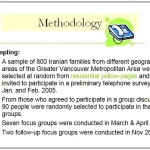
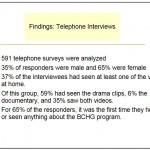
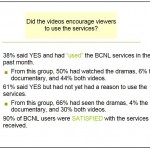
Through a telephone survey, 591 Farsi-speaking adults were interviewed in November and December 2004. 35% of the participants were males and 65% were females. The preliminary findings show that 36.5% of the participants had seen the aired videos, from which, 59.7% watched at least one of the ‘drama’ clips, 5.1% watched only ‘documentary’ clip, and 35.2% watched both types of video. In addition, 34.8% of the respondents claimed that they were aware about the program before watching the videos, while 65.2% said they leaned about the services only after watching the videos. From this group, 11.7% said they called the BC NurseLine for their own or their children’s health problems in the past month. 60.7% also indicated that they would use the services in the future whenever it would be needed. 28% considered the videos as “very good” and thought they could deliver relevant messages and 18% expressed their wish to increase the variety of subjects and increase the frequency of video clips.
BC Place – Session 3, Tuesday, May 30, 2006 from 10:30 – 12:00
Abstract Title: Introduction to Action Schools! BC: Classroom Action
Presenters:
Bryna Kopelow and Jennifer Fenton
Action Schools! BC Support Team
#228 – 1367 West Broadway
Vancouver, BC V6H 4A9
Objective:
To introduce the Action Schools! BC framework and provide an opportunity to experience some of the model’s best practices.
Summary:
Action Schools! BC is a best practices model designed to assist schools in creating individualized action plans to promote healthy living. The Action Schools! BC Support Team will present this exciting initiative highlighting the six Action Zones. Participants will experience first hand how Action Schools! BC is providing more opportunities for more children to be more physically active more often.
BC Place – Session 3, Tuesday, May 30, 2006 from 10:30 – 12:00
Abstract Title: Action Schools! BC: Increasing physical activity through a school-based physical activity intervention
Presenting Author:
Laura Kravetsky, BESS, Student
Faculty of Medicine
Experimental Medicine Program
University of British Columbia
c/o #575 – 828 West10th Avenue
Vancouver, BC V5Z 1L8
Additional Authors:
Katherine Reed, MSc,
School of Human Kinetics
University of British Columbia
Dr. Patti-Jean Naylor
School of Physical Education
University of Victoria
Heather Macdonald, BSc
School of Human Kinetics
University of British Columbia
Objective:
Physical inactivity is associated with chronic disease, including obesity and Type II Diabetes. This problem is increasing among school-age children in British Columbia. Therefore, the purpose of this study was to determine whether Action Schools! BC (AS! BC), a school-based physical activity model, could increase physical activity levels among children.
Methods:
This was a 29-month randomized controlled trial. Students were randomized by school to participate in the AS! BC model (7 schools, n=235) or to continue with their usual school practice related to physical activity (3 schools, n=111). The AS! BC model was designed to deliver 150 minute of physical activity per week in 6 ‘Action Zones’ including 15 minutes of classroom-based physical activity daily. Leisure-time physical activity was assessed by the Physical Activity Questionnaire for Children (PAQ-C) and the primary outcome was a general physical activity score (PA score) on a 1-5 scale (1=low active, 5=high active). We used ANCOVA to compare change in PA score between groups with baseline PA score as a covariate.
Results:
At baseline, students were 10.2 (± 0.6) years old. The control group was more active than the AS! BC group (p = 0.05). After 29-months, AS! BC students had a 4.2% increase in PA score whereas students in the control group reported a 4.7% decrease in PA score (p=0.004).
Conclusion:
AS! BC is an effective model for increasing physical activity among elementary school children.