News

Conference 2022 Featured Speaker – Dr. Tim K. Takaro

Dr. Tim K. Takaro. Professor Emeritus and Physician-Scientist, Simon Fraser University. Dr. Takaro’s research is primarily about the links between human exposures and disease, and determining effective public health based preventive solutions to such risks. Head shot of Dr. Courtney Howard within an Indigenous illustration of an eagle and a bear. Artwork is credited to Nisga’a nation artist Peter Thomas McKay.

Dr. Tim K. Takaro

Dr. Takaro is a Professor Emeritus and Physician-Scientist in the Faculty of Health Sciences at Simon Fraser University.

He is husband to Aggie Black and father to Annie and Ben.

He trained in Occupational and Environmental Medicine, Public Health and Toxicology, at Yale, the University of North Carolina and the University of Washington. Dr. Takaro’s research is primarily about the links between human exposures and disease, and determining effective public health based preventive solutions to such risks.

Planetary change poses complex problems for public health never more apparent than during the COVID-19 pandemic. These challenges demand an interdisciplinary approach both in research and action.

To this end, Takaro is a member the Planetary Health Research group at SFU and a Lead Author of the Health Canada 2022 report, Health of Canadians in a Changing Climate: Advancing Knowledge for Action.

His current research program explores the impacts of resource extraction on human health and the relationship to our land and waters.

With immense gratitude to the First Peoples he is beginning to use Indigenous knowledge to relearn environmental health as he tests different interventions in climate action and planet protection.


See the full list of PHABC’s 2022 Conference speakers here.

Conference 2022 Featured Speaker – Sione Tu’itahi

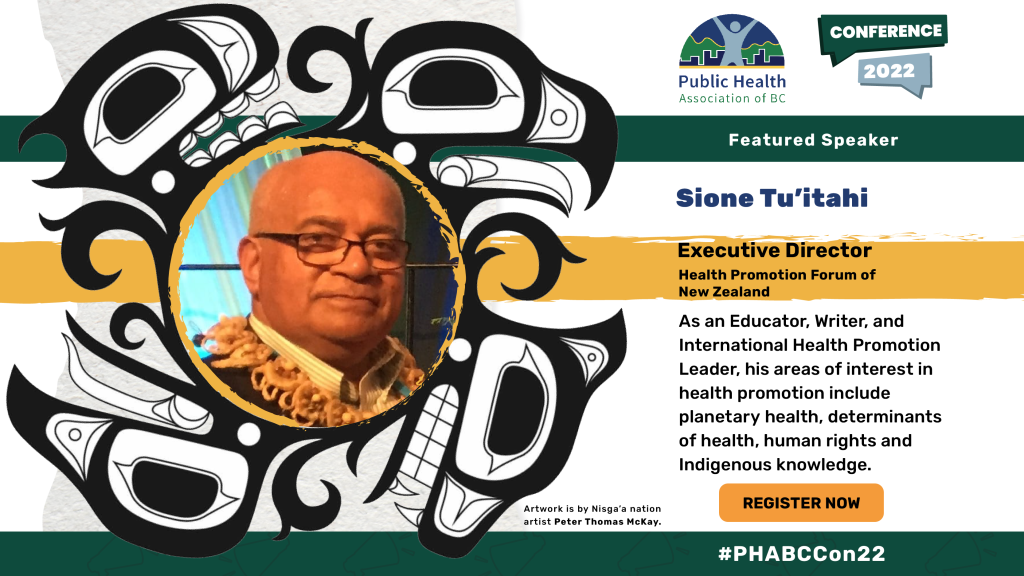
Sione Tu’itahi. Executive Director, Health Promotion Forum of New Zealand. As an Educator, Writer, and International Health Promotion Leader, his areas of interest in health promotion include planetary health, determinants of health, human rights and Indigenous knowledge. Head shot of Sione Tu’itahi within an Indigenous illustration of an eagle and a bear. Artwork is credited to Nisga’a nation artist Peter Thomas McKay.

Sione Tu’itahi

Sione Tu’itahi is the Executive Director of the Health Promotion Forum of New Zealand, Runanga Whakapiki Ake I Te Hauora o Aotearoa (HPF).

Sione is the first Indigenous person to be elected as the Global President of the International Union for Health Promotion and Education (IUHPE).

IUHPE is a global professional non-governmental organisation dedicated to health promotion around the world. For more than 70 years, IUHPE has operated an independent, global, professional network of people and institutions committed to improving the health and wellbeing of the people through education, community action and the development of healthy public policy.

As an Educator, Writer, and International Health Promotion Leader, his areas of interest in health promotion include planetary health, determinants of health, human rights, Indigenous knowledge, community development, public policy, and workforce development.

As a former Journalist and Broadcaster, Sione is the author of several books, academic papers, and children’s stories. As a voluntary Community Worker, he is a member of several national advisory groups in the education, health, and community sectors. He is also a Poet.

In recognition of his significant contributions to health promotion and public health at the national and international levels, Sione was given the 2019 New Zealand Public Health Champion Award by the Public Health Association of New Zealand.


See the full list of PHABC’s 2022 Conference speakers here.

Conference 2022 Featured Speaker – Jeff Masuda

Jeff Masuda. Professor, University of Victoria. A human geographer by training, Jeff is known for his work in environmental justice, urban health inequalities, participatory action research, and critical health promotion. Head shot of Jeff Masuda within an Indigenous illustration of an eagle and a bear. Artwork is credited to Nisga’a nation artist Peter Thomas McKay.

Jeff Masuda

Jeff Masuda is a Professor in the School of Public Health and Social Policy at the University of Victoria and former Canada Research Chair in Environmental Health Equity.

A human geographer by training, Jeff is known for his work in environmental justice, urban health inequalities, participatory action research, and critical health promotion.

Jeff’s research currently focusses on tenant organization for housing justice, including increasing concerns over extreme heat vulnerability, particularly through his role in the Right to Remain Research Collective.

His research also centres on land stewardship as a pathway for urban decolonization through his involvement in A SHARED Future, an international collaboration on Indigenous renewable energy leadership.

Jeff’s academic specialty also spotlights other issues at the intersection of the social and ecological dimensions of health.

Jeff presently leads a standing special section in the Canadian Journal of Public Health, which highlights climate change and health equity.


See the full list of PHABC’s 2022 Conference speakers here.

Conference 2022 Featured Speaker – Dr. Chris Buse

Dr. Chris Buse. Assistant Professor, Simon Fraser University. Dr. Buse’s research focuses on the impact of climate change on health equity and the public health response; and the health impacts of natural resource development. Head shot of Dr. Chris Buse within an Indigenous illustration of an eagle and a bear. Artwork is credited to Nisga’a nation artist Peter Thomas McKay.

Dr. Chris Buse

Dr. Chris Buse is an Assistant Professor at Simon Fraser University’s Faculty of Health Sciences.

Dr. Buse’s research operates at the interface of the social and ecological determinants of health, aiming to redress the differential and often avoidable exposures to the ill-health effects of environmental changes which are worsened by systemic forms of socioeconomic marginalization and oppression.

His research program is underpinned by a focus on environmental health justice, and is animated by two inter-related areas of interest: the impact of climate change on health equity and the public health response; and the health impacts of natural resource development.

Dr. Buse has held numerous competitive awards and high-profile research positions, including as Senior Research Scientist and CIHR-funded Postdoctoral Fellow with the University of British Columbia’s Centre for Environmental Assessment Research, and MSFHR Postdoctoral Fellow and Inaugural Lead Researcher for the University of Northern British Columbia’s Cumulative Impacts Research Consortium.

He holds a PhD in Public Health from the University of Toronto’s Dalla Lana School of Public Health, a MA in Sociology from the University of British Columbia, and a BA in Sociology and Political Science from the University of Alberta.


See the full list of PHABC’s 2022 Conference speakers here.

Conference 2022 Featured Speaker – Dr. Courtney Howard

Dr. Courtney Howard. Emergency physician. Chief Drygeese Territory. Dr. Howard is a globally recognized leader on the impacts of climate change on human and planetary health. She has advanced policy and advocacy on multiple planetary health priorities. Head shot of Dr. Courtney Howard within an Indigenous illustration of an eagle and a bear. Artwork is credited to Nisga’a nation artist Peter Thomas McKay.

Dr. Courtney Howard

Dr. Howard is an Emergency Physician in Chief Drygeese Territory, and a globally recognized leader on the impacts of climate change on human and planetary health.

She has advanced policy and advocacy on active transport, ecoanxiety, movement-building, plant-rich diets, fossil fuel divestment, carbon pricing, coal phase-out, hydraulic fracturing, vaccine equity, and health impact assessments.

She led the 2017-2019 Lancet Countdown on Health and Climate Change Briefings for Canadian Policymakers, was the 2018 international policy director for the Lancet Countdown, and has researched wildfires and menstrual cups.

Dr. Howard is Past-president of the Canadian Association of Physicians for the Environment and sits on the boards of the Canadian Medical Association and the Global Climate and Health Alliance.

She is part of the Steering Committee of the Planetary Health Alliance, the WHO-Civil Society Working Group on Climate Change and Health and the Editorial Advisory Boards of the Lancet Planetary Health and the Journal of Climate Change and Health. She is delighted to be spending 2022/2023 in the UK completing a Master in Public Policy at Oxford.

When not deep in a literature review or seeing patients in the ER, Dr Howard can often be found enjoying the great outdoors and dancing with her two daughters.


See the full list of PHABC’s 2022 Conference speakers here.

PHABC Conference 2022 – Call for Abstracts has been Extended until October 10th!

Our Planet, Our Health:

Creating Well-Being Societies & Making Peace with Nature

November 9th- 10th, 2022

Victoria Conference Centre, Victoria, BC

All sessions are in person


ONLINE ABSTRACTS SUBMISSION: Extended until October 10th! Click here to submit yours today


SUBMISSION DEADLINE: Extended until October 10th, 2022 at 5:00 pm


All successful abstract submissions will have access to a discounted conference registration rate.


Call for Abstracts

Individuals and groups are invited to submit abstracts for one or more of the following presentation format(s):

  • Oral presentation (15-20 minutes)
  • Poster presentations (in-person “walk about” during networking session & on display both days)
  • Workshop (1.5 hours)


Based on the restricted opportunities for oral presentations, we strongly encourage applicants to consider structuring their proposals, particularly if they are practice-based research, around a poster presentation. The poster session, being held concurrently alongside the networking event on November 9th, will be designed as a ‘walk-about’ in order to structure maximum interaction with the presenters and their work.


Workshops are intended to be an interactive opportunity to focus on a particular topic related to the conference themes in detail and/or to build skills or resources in relation to the theme.


Abstract Submission Guidelines

Those submitting abstracts will be required to submit the following information:

  • Presenter & co-presenter professional designations & contact information
  • Presentation format & conference theme
  • Presentation title
  • An abstract of 250 words or less


Please note that the information provided in the abstract submission will be used to describe your presentation in the final program should your abstract be selected. Please ensure your description is accurate, fully proof-read and all presenters are listed.


If your abstract describes primary or secondary research, you are encouraged to submit an abstract covering: background, methods, results and discussion/conclusions.


Those submitting practice-based abstracts are encouraged to include information on: Purpose, focus/content, significance for the theme and target audience.


Evaluation Criteria

Due to limited space and the need for the most relevant and highest quality program, the Scientific Program Committee (SPC) has outlined several criteria by which the quality and relevance of abstracts will be judged.


Each abstract will be scored out of a total possible 7 points, each category listed below will be given a score between 0 and 1 and each score added together for the final score. The descriptions below represent a score of 1 (full marks) for that category:


  1. Asset- & Strength-Based: Approach is explicitly focused on reservoirs of strength and resilience, even in the most disadvantaged communities, as ‘assets’ for health, including geography (rural/remote/Indigenous/inner city).
  2. Action-Oriented: Actions are evidence-informed, population level interventions & focused on the big-picture, instead of on immediate goals.
  3. Partnerships & Multi-Sectoral Collaboration: Collaboration is focused on partnerships with various stakeholders, mediators & facilitators of change, focused on collective impact and the inclusion of affected communities.
  4. Innovative: Innovation and complex systems thinking is evident. Partners encouraged to take initiative, innovate & transform into leaders themselves.
  5. Engaging & Experiential: Participatory and experiential focus is strong, effective and woven throughout.
  6. Relevance to Conference: Highly relevant to conference topic, themes & objectives.
  7. Quality: High quality. Would shine at a national conference.


Call for Abstracts is Now Open! Click here to submit


If you have any questions, please contact conference@phabc.org


Loader Loading...
EAD Logo Taking too long?

Reload Reload document
| Open Open in new tab

Download [1.58 MB]